Why Inflammation in Your Gums Deserves More Attention


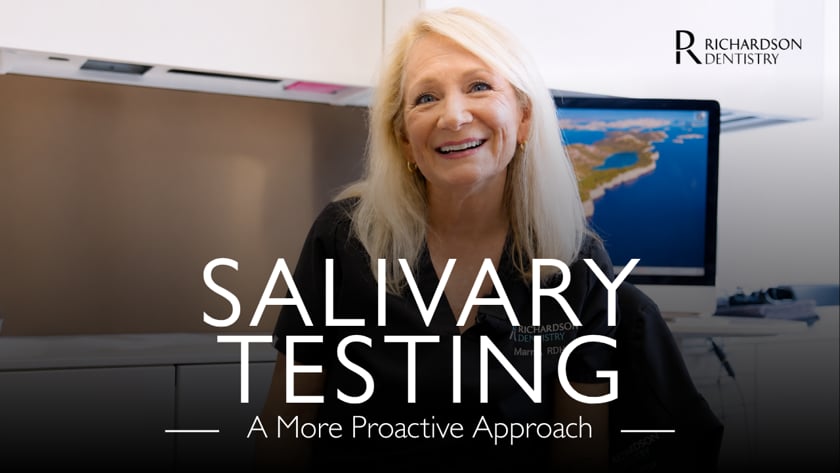
Salivary testing at Richardson Dentistry in Richardson, TX, provides another way to evaluate oral health by examining the microorganisms and other markers present in a patient’s saliva. In addition to traditional dental exams, radiographs, and periodontal evaluations, a salivary pathogen profile can provide information about bacteria, viruses, fungi, immune resistance, and immune resilience, supporting the practice’s personalized, proactive approach to preventive and wellness-focused dentistry.
Hi, I’m Marny with Richardson Dentistry, and I’m a hygienist with our dental team.
For decades in dentistry, we have focused on everything we can see in the mouth, including radiolucencies and radiographs. We use tools to probe, and that’s how we determine decay and gum disease. Those are measurable things that we’ve been able to use in years past to determine the amount of disease in a patient’s mouth.
But we now know, because there is so much connected between the mouth and the body, that they’re highly connected. We are now able to do salivary testing. The microbiome, our spit in our mouth, is very valuable, and it tells us the rest of the picture, the rest of the puzzle in the mouth.
It’s a simple, non-invasive test. You just swish with a little solution, and then you spit it into a little tube like this, and we send it off to a lab. The lab sends us back a profile.
It’s a pathogen profile of the patient’s saliva. It tells us bacteria. It tells us viruses. It tells us fungus. It tells us immune resistance and immune resilience.
It even helps us put together protocols and tools to shift that bacterial load. That’s probably the most exciting thing in dentistry right now. We can actually take those measurements from a patient’s pathogen profile, shift the bacterial load in your mouth, and get measurable results.
It allows us to go from reactive dentistry to proactive, preventive dentistry, which is huge when it comes to disease in the mouth.
The pathogen profile that comes out of salivary diagnostics is what allows us to provide an individual, proactive, preventive care program for our patients for the long term.
Salivary testing is a simple, non-invasive diagnostic test that analyzes a sample of a patient’s saliva. Marny explains that the sample is sent to a laboratory, which provides a pathogen profile containing information about bacteria, viruses, fungi, immune resistance, and immune resilience in the patient’s mouth.
The dental saliva test is performed by having the patient swish with a solution and then spit into a small collection tube. Richardson Dentistry sends the sample to a laboratory for analysis, and the laboratory returns a pathogen profile that provides additional information about what is happening within the patient’s oral microbiome.
A salivary pathogen profile can provide measurable information about bacteria, viruses, fungi, immune resistance, and immune resilience. According to Marny, this information gives the dental team another part of the oral health picture and can help guide individualized protocols intended to shift a patient’s bacterial load.
Richardson Dentistry uses salivary diagnostics to support a more proactive and individualized approach to preventive care. Marny explains that measuring a patient’s pathogen profile can provide information that traditional visual examinations and diagnostic tools do not provide by themselves, helping the team better understand disease within the mouth.
Salivary testing supports preventive dentistry by giving the dental team measurable information about a patient’s oral microbiome and pathogen profile. Marny explains that these findings can help Richardson Dentistry develop individualized protocols rather than relying only on a reactive approach after signs of oral disease have already become apparent.
1150 State St suite 200
Richardson, TX 75082
| Monday | 7:00 AM - 3:00 PM |
| Tuesday | 9:00 AM - 5:00 PM |
| Wednesday | 9:00 AM - 5:00 PM |
| Thursday | 7:00 AM - 3:00 PM |
| Friday | Closed |
| Saturday | Closed |
| Sunday | Closed |